

Human Centered Leadership Podcast

By nature, I do not usually talk about the way I run our company. Having said that, I was not sure what to expect when Kul Mahay approached me for his ‘Human-Centered Leadership’ podcast interview.

I, however, agreed to talk to him. I truly believe in the ideas that I mentioned in the interview and have been practicing them for the past several years. Here are the key segments from the podcast with Kul:

Subash's Views on Leadership + Tips

(5 minutes)

Listen to the Full Podcast!

(25 minutes)

Subash's Thoughts on His Passion & Business Titles

(2 minutes)

AGORA's Culture

(2 minutes)

By nature, I do not usually talk about the way I run our company. Having said that, I was not sure what to expect when Kul Mahay approached me for his ‘Human-Centered Leadership’ podcast interview. I, however, agreed to talk to him. I truly believe in the ideas that I mentioned in the interview and have been practicing them for the past several years. Here are the key segments from the podcast with Kul:

    1. Subash’s thoughts on his passion and business titles (about 2 minutes)
    2. AGORA’s Culture (around 2 minutes)
    3. Subash’s views on Leadership and his tips (around 5 minutes)

Below is the full podcast (around 25 minutes): Human centred, naturally! Subash Dave | Human Centred Leadership Podcast with Kul Mahay

Proud to be an American

A message from our founder, Subash Dave’.

This Fourth of July reminded me of the time I first came to the United States in 1970 for higher education. I received my Master’s in Industrial Engineering from Illinois Institute of Technology in Chicago. After graduation, I worked for a few companies for 14 years, before I started AGORA in 1985.

I became a U.S. citizen in the late 1970s. I am proud to be an American citizen.

Relationships Matter (Part 4)

Lasting Relationships flourish when all parties trust each other. Greed, or a breach of that fragile trust by either side, fractures the relationship and makes it impossible to restore it to its original trust level.

We believe in transparency and good relationships with our customers, employees and suppliers – all key stake holders in a successful business.

We must respect all stake holders and ensure that each one of them is honest, trust each other and allow each one’s business to grow.  If one stake holder gets greedy, the relationship sours and as discussed before, the relationship cannot be restored to its original trust level.

We treat our customers as kings, we treat our employees as family and we treat our supplier-partners with respect as well as pay them on time so they can function efficiently.

We are fortunate to have customers, employees and suppliers, who have been with us for over 30 years.  We thank them for their continued support.

Relationships Matter (Part 3)

Lasting Relationships flourish when both parties trust each other. Greed, or a breach of that fragile trust by either side, fractures the relationship and makes it impossible to restore it to its original trust level.

We all worked very hard back in the early days; usually seven days a week. We also had many breaks in business; one that comes to mind is from a large pharmacy chain.

Mr. Blackburn had a vacuum-forming business. I used to deal with him when I worked at my old company. Mr. Blackburn was older than me and he liked my tenacity in business.

When I started AGORA, I pursued this secured business of a large pharmacy chain. This company was looking to reduce the cost of its shopper baskets. The shopper baskets were made from vacuum-formed ABS plastic and then silk-screened with the company logo.

Mr. Blackburn redesigned the basket using polyethylene plastic rather than ABS plastic. Instead of silk-screening a logo on a basket afterwards, he debossed the logo while forming the basket thereby manufacturing the entire basket in one process.  This reduced the cost of the basket, as well as, made for a stronger and more durable basket.

Here is the break: this pharmacy chain would give us a large order of 50,000 baskets per PO.

We would in turn, place an order with Mr. Blackburn and then receive 50,000 baskets by truck.

We would have an empty truck parked beside the truck full of baskets. All of us would go out, and randomly check the quality of the baskets, then start filling the empty truck with the inspected baskets.

This process would take our 6 employees about 6 to 8 hours.

Our customer would pay us within 10 days. This check received in a short time would provide Agora operating cash to purchase raw materials and pay our employees, etc. We would receive a 50,000 piece order twice a year. With this huge break, our business was able to sustain for about two to three years.

AGORA was able to improve the basket design and reduce the price of the basket thus creating a win-win situation for all parties involved. Knowing the innovative Mr. Blackburn plus the trust that our customer placed in AGORA, provided this break for us. 

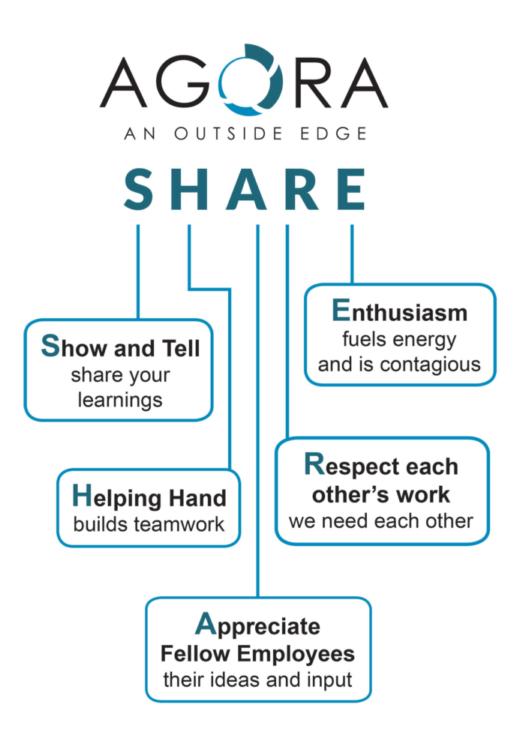
SHARE

A Message from our Founder, Subash Dave’.

In the early years of AGORA, we had a small team of 8-10 employees.

We all had the same goal at AGORA – to stay in business and grow. We were all so consumed by our day-to-day work, we did not take time to focus on the culture that I wanted to cultivate at AGORA. Some of these values include respecting one another’s job, appreciating your team for their ideas and input etc.

I wanted to come up with a concise and easy-to-remember means, to communicate the concept of ‘SHARE’ to our team. I also thought that it would be nice to fit this on business card stock, so I went to work on it.

The ‘SHARE’ card was born and over 35 years later, we still believe in ‘SHARE’ and continually work on instilling this culture into Team AGORA.

Here is a simple way to explain TEAMWORK to our international workforce. 

Show & Tell
Share your learnings.

Helping Hand
Builds teamwork.

Appreciate Fellow Employees
Their ideas and input.

Respect Each Other’s Work
We need each other.

Enthusiasm
Fuels energy and is contagious.


The Branding of AGORA (Part 2)

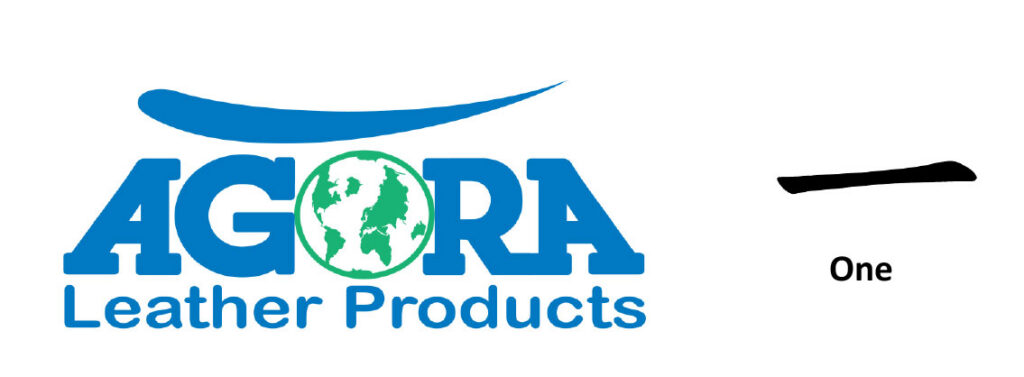
In 2011, a stylized horizontal stroke (representing the number one in Chinese) replaced the briefcase above the word AGORA.

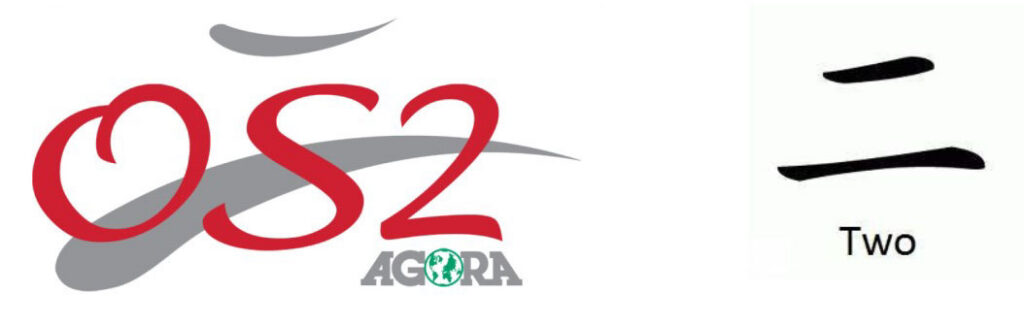
It was also around this time, that our second factory (this one in China) got the OS2 logo. The ‘OS’ in OS2 stands for Overseas and the logo has 2 stylized horizontal strokes (representing the number two in Chinese).

In 2014, ‘AGORA Leather Products’ became ‘AGORA Edge’.

The ‘Edge’ in the name signifies the competitive edge our customers gain by working with AGORA. Also, literally it is demonstrative of the outside edge our products provide while protecting our customers’ components.

CHAKRA (the letter ‘O’ in AGORA)
A channel through which energy flows.

Chakras are key to balance and harmony. They also symbolize joy, communication and focus. These are traits we strive to improve upon constantly.

Another key pillar of AGORA’s growth over the years is our belief that products and processes can always be improved and that there always is a better way to do, almost anything.

This is embodied in our tagline – We believe in a better way.

AGORA Branding (Part 1)

In 1985, I needed a business name for my new company. I was looking for something that started with the letter ‘A’ so it would be listed at the beginning of the big ol’ telephone directory.

The word AGORA caught my imagination. Upon further reading, it met more of my criteria in addition to beginning with the letter ‘A’. The word AGORA has a multicultural identity – in Greek and Turkish, AGORA means ‘Marketplace’, and in Portuguese, AGORA means ‘Now’.

The word ‘Now’ also fit right in with my ‘sense of urgency’ in making things happen, like NOW.  It eventually went on to become one of the tenets that AGORA is based on, to this day. By this time, it was a no-brainer that ‘AGORA’ was the name I was looking for. The rest, as they say, is history.

AGORA was originally called AGORA Leather Products. Leather, inherently is symbolic of Quality.

Moreover, leather was also used in the manufacturing of some of the products that AGORA would go on to make. Thus, AGORA Leather Products was born.


Our First Logo Showing the Letter ‘A’ on a Leather Briefcase

Around 2001, the logo was modified to present a softer look that mirrored our bags and cases with rounded corners. The letter ‘O’ was replaced with a globe that is representative of AGORA’s growing international business.


Our 2001 Logo

Relationships Matter (Part 2)

I met Real Ramaciere when I first moved to St. Petersburg, FL in 1980.  Schell, the company I worked for, moved from Cincinnati to St. Petersburg in 1980.

We purchased a building in St. Petersburg. I was the first one from Schell to arrive in Florida, to get the building ready to move in and also set up the factory once the machinery started to arrive.

I was selling off shelving etc., that the company we bought the building from, left behind.

Real Ramaciere was a plant manager at a local watch strap factory. He came to purchase some shelving etc., that is when I first met Real. Real and I connected during this brief meeting. Real was older than me and took a liking to me.

Going forward, when I started AGORA, Real was at the factory every day.

I Always Remember Two Things Real Told Me

“Never look back on negative things.”

“Always follow up on what you started until it is completed.”

This advice was instrumental in my focusing on the business from the very first day. Every evening after Real left his factory, he would come to my factory and help us fix machine problems and make process improvements. Real would first ask me if I checked the machine he fixed the day before.

Invariably I would say, “Real, I was so busy up front that I did not get a chance to check.” So he would get up from the chair, strut to the plant, check on the machine and any other help we needed in the plant. He would come back and say, “Subash, where is my beer?”

Both of us would have a beer together and we talked about my day, new business and any other problems we had.

He owned our problems and took care of them.

What a blessing!

Diversity Brings Growth (Part 4)

Nam came to the U.S. as a refugee from Cambodia. While in Cambodia, he had to leave school to become a farm help, and no education to fall back on. His father had a rice mill and his mother had a tailoring business. He had some background in sewing, just by watching and helping his mother.

He learned to design and hand-craft prototypes at this first job in the U.S. He was our designer. Backed by our self-taught designer and can-do attitude, we accepted all challenges and talked to customers about their wish-list of products. Nam always delivered the customer’s vision. He also made sure to add a couple of extra features that enhanced the product.

Our customers loved it. Being in the learning phase, we made two identical prototypes – one sent to our customer and the other was kept for our reference.

This twin-prototype method served a couple of purposes:

  1. If the customer approved the design, our reference prototype became our production sample.
  2. If there were additional design changes, we would then discuss those changes with our customer, while both parties had the exact prototype in hand. This made sure that we were always on the same page.

These ideologies have since become the hallmark of our design process. We adhere to these design principles to this day. This is the AGORA way of designing products, “with and for our customers”.

Diversity Brings Growth (Part 3)

In the beginning, we had many people on our team from Southeast Asia. Most of them were refugees from Cambodia, Laos, and Vietnam.

These refugees came from a culture where they usually had limited resources, and therefore they had learned to make the best use of what they had. Their creativity brought many great benefits to AGORA in the early days.

With their knowledge and frugal nature, we began to save remnants of leather and other small pieces of leftover materials. We recycled these materials to manufacture other parts in the early years. This helped reduce our material costs and helped our cash flow.

As you all know, cash flow is always critical, even more so in the first two to three years of business.